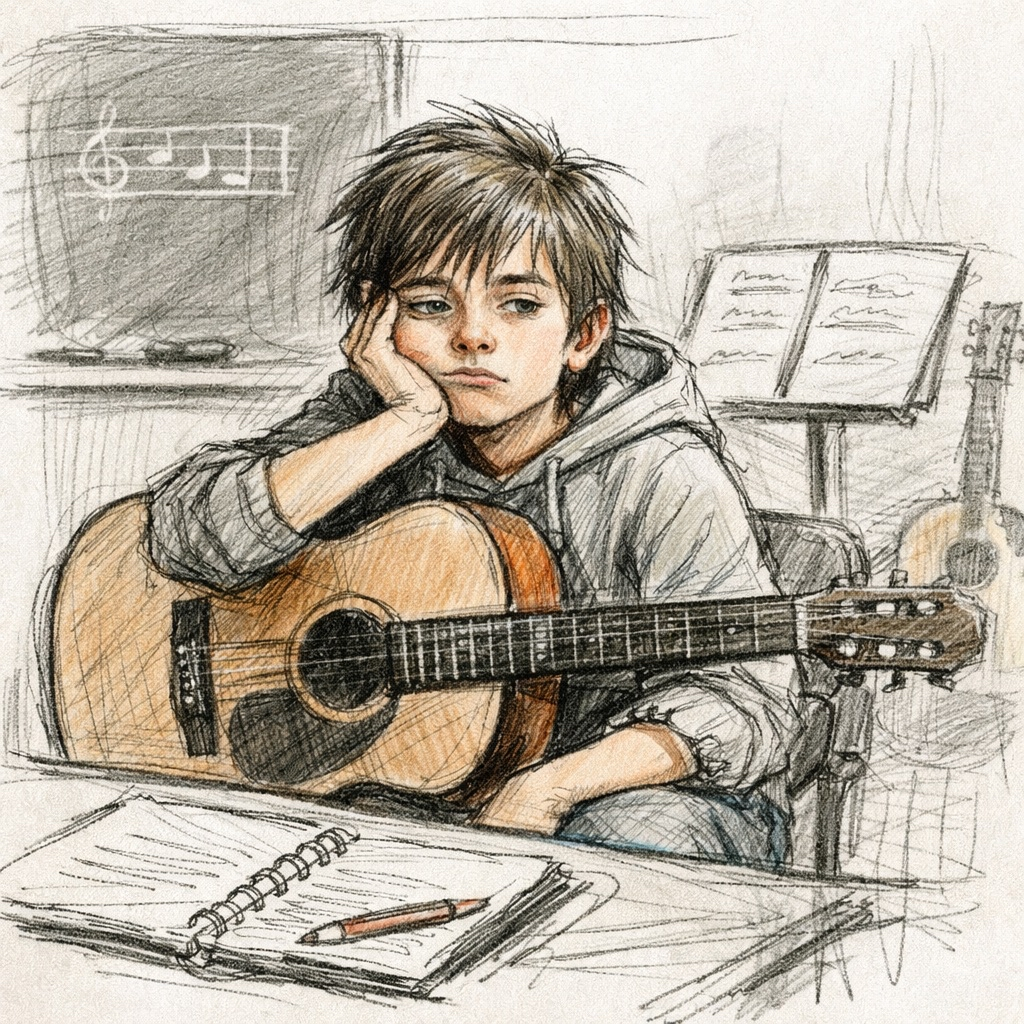
There is a conversation that happens in guitar teachers' circles with the regularity of a metronome and roughly the same emotional range. It goes like this: "My student is eight, loves lessons, plays great in the room, and then goes home and apparently forgets that guitars exist." The teacher sighs. Everyone nods. Someone orders another coffee.
Kids not practicing is not a new problem. It is not a phone problem, a video game problem, or a this-generation problem. It is a motivation problem — and motivation, it turns out, is something teachers can actually do something about. Not everything, but enough.
I've been watching this dynamic for a long time, talked to a lot of teachers, read the research that exists (and there's more than you'd think), and I've landed on some things that consistently work. Not magic. Not a protocol. Just a smarter way of thinking about what practice actually is for a kid.
First: The Practice Problem Is Often a Repertoire Problem
Ask yourself — honestly — how interesting is the piece you've assigned? Not interesting to you. Interesting to a nine-year-old who could be doing literally anything else.
This is the part where many teachers get defensive, so I'll say it plainly: a lot of beginner repertoire is boring. It was written to be pedagogically efficient, not to make a child want to run home and play it seventeen times. "Mary Had a Little Lamb" teaches step-wise motion. It does not make a kid feel like a guitarist.
The first intervention — before any practice strategy, before any reward chart, before any conversation with parents — is to audit your repertoire. What does the child actually want to play? Not a simplified version of something they've never heard. The actual song they hum in the hallway. Start there, build technique around it, use method books as a supplement rather than the main event.
Kids practice what they want to hear themselves play. This is not laziness — it's a completely rational approach to voluntary activity that most adults have forgotten they share.
Chord sheets are one of the most underrated tools for exactly this reason. A child who can strum along to a real song — chords they recognize, a melody they know — has an immediate reason to pick up the guitar at home. I've been using Exerzisor for this for a while now, and it's the closest thing I've found to a silver bullet for the home-practice problem. You build the chord sheet once, the student opens it on any device, hits play, and suddenly they're strumming along with the actual recording. Here's what that looks like:
What makes an interactive chord sheet different from a printout isn't the format — it's the context. The student doesn't just see the chords; they hear the song, in tempo, in the right key, and they play along with the actual recording. For a kid, that's the difference between practicing in silence and feeling like they're in a band. Paper gives you the chords. Interactive chord sheets give you the chords and a reason to play them. The guitar gets picked up.
The other thing worth knowing: Exerzisor is free to use for teachers. You can share chord sheets and interactive materials directly with your students — no app to install, no account required on their end. They just click the link.
The Five-Minute Rule (And Why It Works)
The research on habit formation — and there's solid work on this, from BJ Fogg at Stanford to James Clear's popularisation of it — consistently shows that the biggest barrier to a habit isn't lack of motivation, it's the startup cost. The moment between "I could practice" and "I am practicing."
For kids, that gap is enormous. The guitar is in its case. The case is in the corner. The corner is next to the TV. You see the problem.
The fix is embarrassingly simple: make the guitar impossible to ignore. Guitar on a stand in the living room, not in a case in the bedroom. Visible. Accessible. In the way. A guitar on a stand gets played. A guitar in a case gets forgotten. This is not a metaphor. It is physics.
Then: assign five minutes. Not twenty. Not "practice every day." Five minutes. Pick up the guitar, play the song you like, put it down. That's a successful practice session. The reason this works is that five minutes almost always becomes ten or fifteen once the child is actually playing — but the commitment was only five. You've lowered the activation energy to nearly zero.
Ditch the Practice Log. Try This Instead.
Practice logs are a well-intentioned form of psychological torture. The child fills it in (or doesn't), the parent signs it (or forges it), the teacher looks at it with mild skepticism (or genuine despair), and the whole exercise creates an adversarial dynamic around something that should be joyful.
What works better: a single question at the end of each lesson. "What's the one thing you want to be able to play at home this week?" Not "practice these exercises." One specific thing, chosen by the child, that they're excited to nail. Write it on a sticky note. Stick it on the guitar case. That's the assignment.
When they come back next week, you start with that thing. Not "did you practice?" — you can usually tell in the first thirty seconds. Just: "Show me." No judgment. If they nailed it, celebrate. If they didn't, play it together right now, figure out where it fell apart, make it easier, and send them home with a smaller target.
The shift is from practice-as-obligation to practice-as-puzzle. Kids are extraordinarily good at puzzles when they want to solve them.

The universal teacher experience: you've assigned the perfect exercise. They have not touched it.
The Parent Variable (This One's Delicate)
Here's an uncomfortable truth: in most cases where a young student isn't practicing, a parent is somewhere in the equation. Not because parents are bad — they're not — but because the parent's relationship with the guitar, with music, and with "achievement" shapes everything that happens at home.
The worst scenario is the parent who stands over practice sessions correcting mistakes. The child then learns that practicing = being corrected = unpleasant. They will practice exactly as little as necessary to avoid this experience.
The slightly better but still problematic scenario is the parent who asks "did you practice today?" as their only musical interaction with the child. This frames practice as chore completion, which it then becomes.
The best scenario — and you can actually engineer this — is a parent who shows genuine curiosity about what the child is working on without evaluating it. "Can you play me the song you're learning?" Not "are you doing it right?" Just interest. Children practice when they feel like someone wants to hear them play.
Have this conversation with parents early, framed as strategy rather than criticism. Most parents desperately want their child to succeed and have simply never thought about the mechanics of how home practice actually works.
Make Progress Visible
Adults track progress abstractly — we know we're improving because we can play things we couldn't play before. Kids need it concrete. They need to see it.
A simple technique: record a one-minute video of the child playing their piece at the start of a month. At the end of the month, play it back next to a new recording. The difference is almost always dramatic, even after a month of minimal practice — because children improve fast at the beginning. Watching yourself get better is deeply motivating, in exactly the same way that watching a barre chord suddenly ring clean after weeks of muted strings makes you immediately want to practice more.
This is also where a proper lesson platform earns its money. Exerzisor has built-in progress tracking and a trophy system — students can see their own milestones, and so can you. A kid who unlocks a trophy for nailing a new chord has concrete proof they got better. That proof is what keeps them coming back. It's a small thing, but small things compound.
The recording also does something else: it gives the child something to share. With a grandparent, a friend, in a school show-and-tell. The moment playing guitar becomes something you can show other people, it stops being homework and starts being an identity. "I'm a guitarist" is a powerful thing for an eight-year-old to feel. You want to help them feel it as early as possible.
Repertoire That Earns Its Place
I want to come back to this because it really is the load-bearing wall of the whole practice problem. If a child is genuinely excited about a piece, the practice problem largely solves itself. Not entirely — you still need the stand-in-the-living-room, still need the five-minute rule — but the motivation to get there is no longer a battle.
The tricky part is that "what kids want to play" changes constantly, is highly individual, and often doesn't align neatly with method book progressions. This is fine. Your job as a teacher isn't to execute a method book — it's to build a guitarist. The method book is a map, not the territory.
Good sheet music hits the sweet spot: achievable within a week or two of actual effort, sounds impressive enough that the child wants to play it for someone, and teaches something real about the instrument in the process. This is exactly where interactive tabs earn their place. I use Exerzisor for this — you can build sheet music and tabs that the student can actually play along with, hear at the right tempo, and slow down bar by bar when something's tricky. Here's an example:
The difference between interactive sheet music and a printout is the same as the difference between a recipe and a cooking show. Both give you the instructions. Only one makes you hungry. A student who opens this at home immediately hears what the piece is supposed to sound like — no parent required to decode the notation, no guessing if they're playing it right. They hear it, they try it, they adjust. That feedback loop is exactly what practice is supposed to be.
And again — Exerzisor is free for teachers. You assign it, the student opens a link. That's it.
When a student comes in having practiced, it's almost always because they were playing something they wanted to hear themselves play. When they haven't, it's almost always because they weren't. Start there.
The Longer Game
None of this solves the practice problem permanently. Kids go through phases. Summer breaks, school stress, friend drama, a sudden obsession with football — all of it will interrupt practice at some point. What you're building isn't a practice habit so robust it survives all weather. You're building a relationship with an instrument that survives the interruptions and gets picked back up.
The children who are still playing guitar at sixteen didn't practice every single day between ages eight and sixteen. They practiced in bursts, had fallow periods, came back, went away, came back again. What they maintained across all of that was the feeling that playing guitar was theirs — not their teacher's assignment, not their parents' investment, not a scheduled activity. Theirs.
And the best thing you can do for that? Give them material that makes them sound good, teach them things they want to play, and make it easy to pick the guitar up. Everything else is commentary.