Let me be upfront about something: I am a guitar teacher. I teach other people how to play guitar. I have done this for years. I am reasonably good at it.
And there are things Paul Gilbert does on a guitar that I genuinely do not understand.
Not "I understand it theoretically but it's hard." I mean: I watch his hands, I slow the video down, I watch again — and there is a gap between what I see and what I hear that my brain cannot fully close. Some things he plays are not mysterious. They are fast, yes, but you can trace the logic: pick goes down, pick goes up, string changes here, position shift there. You can diagram it. You can practice it. You will never play it as well as he does, but you understand what he is doing.
Other things he does, I cannot fully diagram. And after years of teaching and playing, I have made peace with the fact that this is fine. It is, in fact, one of the better feelings in music: watching someone do something you can't entirely explain.
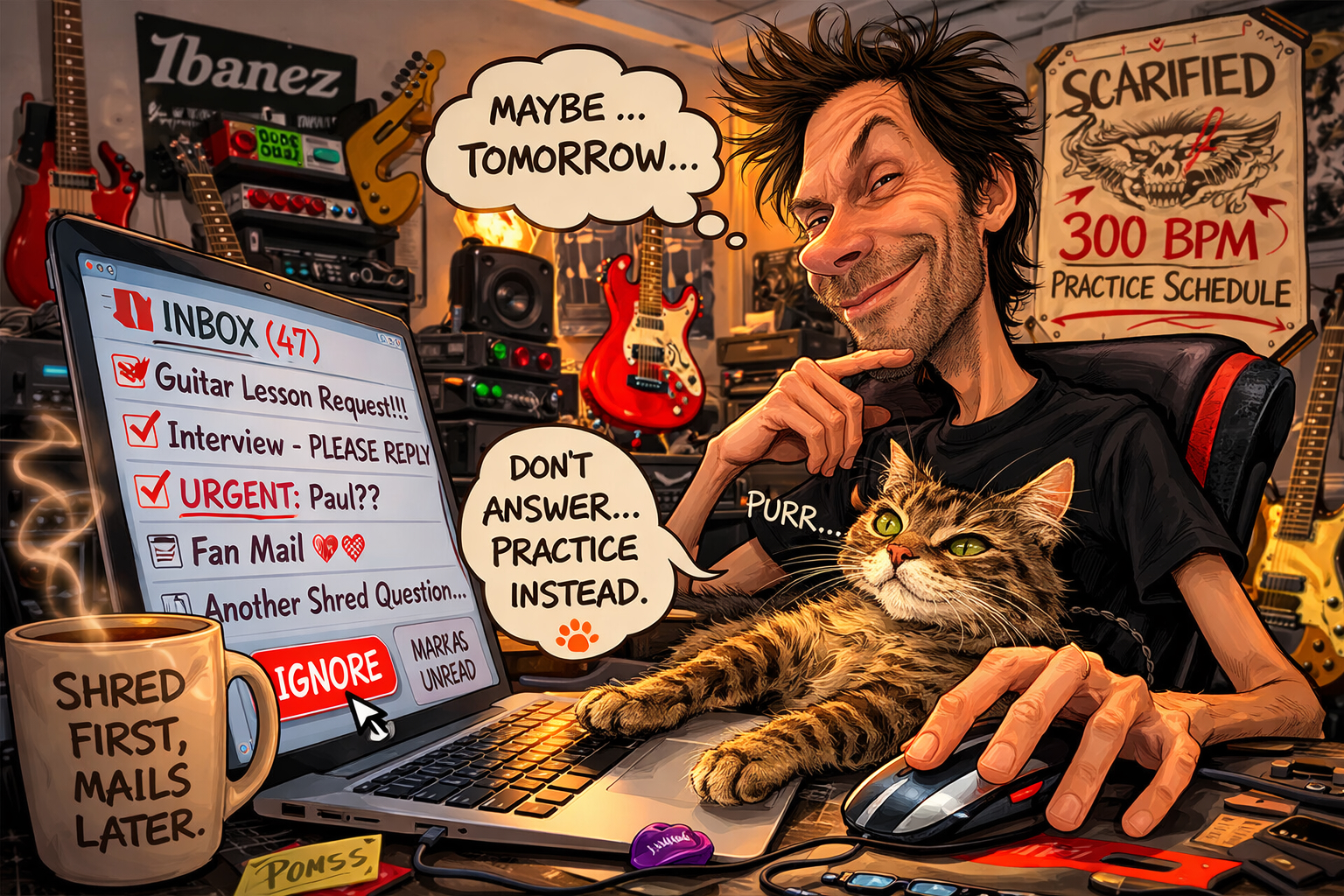
I wrote him five emails.
Not fan mail, not "please sign my poster." I wanted to talk to him. Ask him about a specific thing I'd been thinking about — the way his phrasing breathes in a particular way that most shred guitarists' phrasing doesn't. I wanted to understand it from the inside. I thought: he's a teacher himself (he's taught at Musicians Institute in Hollywood), maybe he'd find the question interesting.
Five emails. Different contact addresses, different phrasings, different subjects. One of them I wrote very carefully over two days and thought: this one is good. This one is interesting enough that a person who cares about guitar would want to respond.
Complete silence. Not a "no." Not a "not the right place for this." Just: nothing. The void. The kind of non-reply that leaves you genuinely unsure whether the email even arrived or whether you are simply being ignored with exquisite professionalism.
No worries, Paul. Genuinely. You are the man.
Here is the thing about Paul Gilbert that gets lost in the conversation about his speed: he is, at the core, a musical guitarist. The speed is real and the speed is extraordinary — but speed is what you notice first, not what makes him worth watching fifteen years later.
What makes him worth watching is the control. The sense that every note is exactly as loud as he wants it to be, placed exactly where he intends it to land, and that the quiet moments are as deliberate as the loud ones. Shredders who peak early are usually the ones who never figured out the quiet moments.
Watch this.
This is from Guitar Wars, a concert event held in Japan in 2003 — we've covered what makes this performance technically remarkable, but what I want to talk about is the human side of it. Paul Gilbert performing "To Be With You" — the Mr. Big ballad that hit #1 on the Billboard Hot 100 in 1992 and topped the charts in eleven countries, which remains the most unlikely chart achievement in the history of a band whose lead guitarist once performed with a power drill.
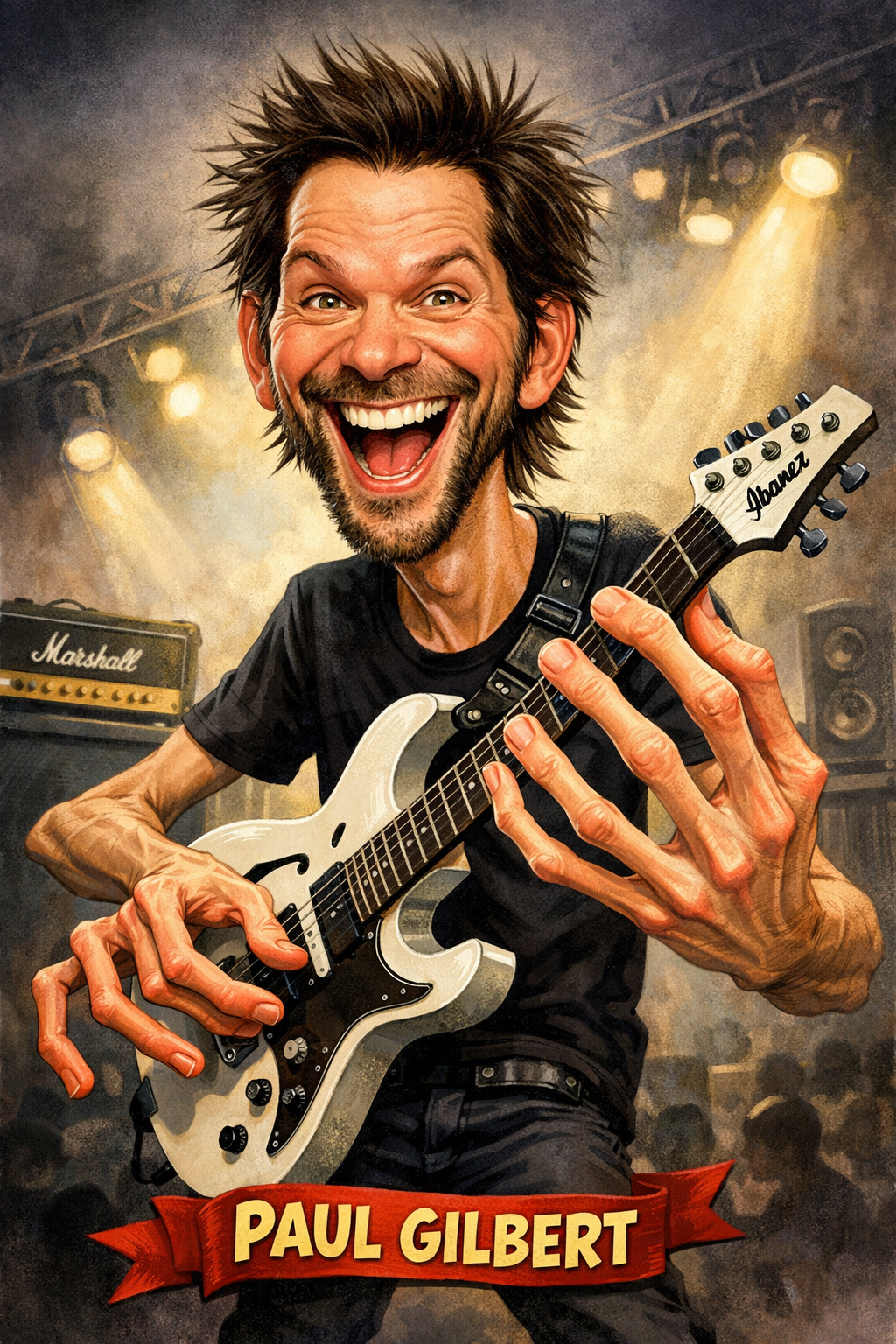
He is playing it fingerpicked. No plectrum. He is tapping with his right hand simultaneously. And he is singing the melody. All three things, at the same time, unhurried.
I want to be precise about why this is harder than it looks, because it looks deceptively easy and that's actually the point.
Fingerpicking and tapping at the same time means you are using the same hand for two different jobs — plucking strings with the fingers while also tapping notes on the fretboard with the tip of one or more of those fingers. The left hand is fretting chord shapes and moving positions. And meanwhile the voice is carrying the melody, which means your brain is managing pitch, rhythm, and breath on the vocal track simultaneously with the physical mechanics of both hands doing separate tasks.
Most guitarists who can play like Paul Gilbert do not also sing. Most guitarists who sing at his level do not also play like Paul Gilbert. The combination isn't just additive — it's multiplicative in difficulty, because the brain systems involved in singing and in playing guitar are not the same systems, and getting them to run in parallel without either one collapsing is a non-trivial thing.
He does it like it's nothing. That is the most suspicious part.
I think about this a lot when I'm teaching. There's a version of guitar progress that is entirely about adding things — more speed, more techniques, more scales. Add the tapping. Add the sweep picking. Add the legato runs. More, more, more.
And then you watch someone like Paul Gilbert play "To Be With You" at Guitar Wars, and you realize the progress you're actually after isn't more. It's control. It's the ability to play exactly as quietly as the moment requires, exactly as slowly as the song asks for, with the same command you'd bring to the fast parts. A student who can play a passage at 160 BPM but can't play it at 60 BPM with genuine feeling has learned half the thing. Maybe less than half.
I tell my students this regularly. I'm not sure how many of them believe me, because when you're fifteen and you want to play Eruption, the soft-playing lecture is not exactly what you came for. Fair enough. I didn't believe it either at fifteen. You have to arrive at it yourself, usually by watching someone who is plainly better than you play something quietly and realizing you cannot replicate it. Not the notes — the quality of the notes.
Paul Gilbert has been that person for me more than once.
He put out an album in 2023 called The Dio Album, in which he used his guitar to replicate Ronnie James Dio's vocal melodies — not to solo over them, not to accompany them, but to sing them, instrumentally, with all the phrasing and vibrato and dynamic shape that Dio used in his actual voice. It is a deeply strange and deeply good album. It is the act of someone who has been listening very carefully to singers for a long time and has decided to use the guitar as a voice, literally.
This makes the Guitar Wars performance make more sense in retrospect. The fingerpicking, the singing, the tapping — it's all part of the same project: trying to get the guitar to do what a voice does. Breathe. Push. Pull back. Land on a note and stay there. The pick is literally the first point of contact between you and the string — but at the level Gilbert is playing, the pick is almost irrelevant. The intention is everything.
I don't know if I'll ever fully understand how he does it.
I wrote him five emails. He didn't answer. He's still one of the best guitarists I've ever watched. These things coexist without contradiction.
If I ever met him, I would shake his hand and say: you are the man, man.
And then I would probably ask him about the phrasing thing. Just one more time.
Related: Bumblefoot Played the Pink Panther Theme on a Fretless Guitar in a Rainstorm — another guitarist doing something unexpected with a song you already knew
Also: Is Ichika Nito Actually Miming? — on watching guitar players and not entirely trusting what you see