Everyone told you to squeeze harder. The internet, your guitar teacher, that guy at the open mic who plays Wonderwall with a capo on the third fret and talks about "the craft." They were all wrong.
Barre chords don't fail because you're weak. They fail because your thumb is in the wrong place and your wrist is doing something your wrist should never do. Strength is what people blame when they don't know the actual answer, kind of like blaming traffic when you're late because you left twenty minutes too late.
Here's the actual answer.

Your Thumb Is the Villain
When you lay your index finger across all six strings and get that buzzy, half-muted disaster that sounds like a guitar being gently strangled, your thumb is sitting on top of the neck like a tourist on a hotel balcony. Comfortable, scenic, completely useless for the task at hand.
The fix is almost insulting in how simple it is. Move your thumb behind the neck — directly behind your index finger, not above it, not off to the side treating the headstock like a personal armrest. Then drop your wrist slightly forward and tuck your elbow in toward your body.
Barre chords require roughly three to four times the pressure of open chords. You can try to brute-force that with finger strength, and you'll have a sore hand and a reason to sell your guitar on Reverb within the month. Or you can use leverage. Thumb behind the neck gives you leverage. The thumb is not decorative. It's also not a hood ornament, though some people treat it like one.
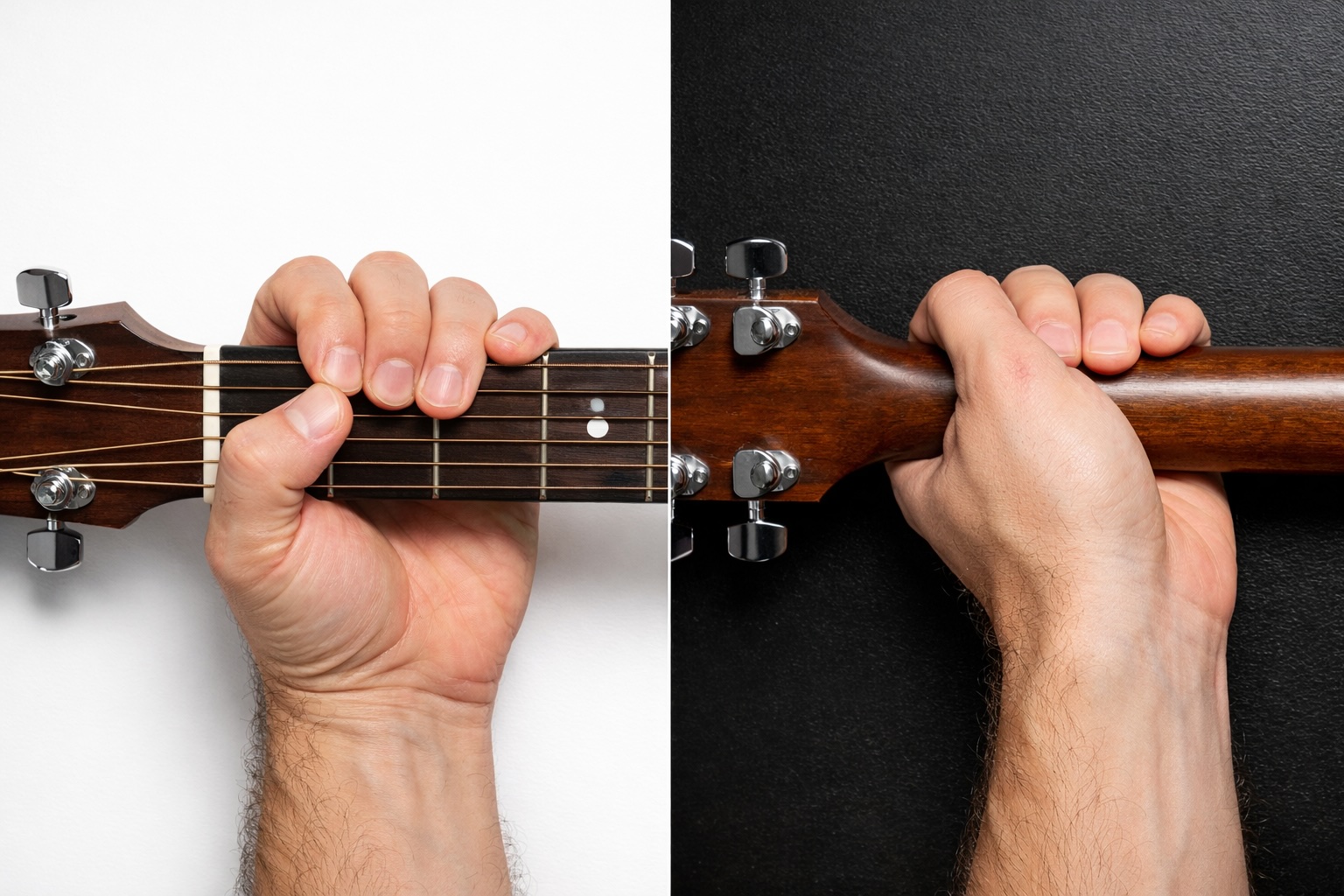
The First Fret Is a Trap
Every beginner goes straight for the first fret because F major is the first barre chord in every method book ever printed. This is like learning to swim in the deep end with ankle weights. Technically possible. Practically idiotic.
The nut end of the neck has the highest string tension and the widest fret spacing. Everything is harder there. Everything. The frets closer to the body have lower tension, tighter spacing, and more forgiveness for fingers that are still figuring things out.
Most guitar teachers worth their hourly rate agree on this: start with a barre chord at the 5th fret. A Bm or Am shape. Get it clean there first. Then migrate toward the first fret over days and weeks, like a civilized person descending a staircase instead of jumping off the roof.
The Roll Nobody Tells You About
Your index finger is not a rolling pin. Stop pressing it flat across the strings like you're trying to iron a shirt on the fretboard.
The bony edge of your index finger — the side facing the headstock — is where the magic actually happens. That edge has fewer nerve endings, less soft tissue, and more bone surface, which means less muting interference from the fleshy bits between your finger joints. Roll your finger slightly toward that side instead of pressing straight down.
The underside of your finger is full of grooves and soft tissue between the knuckle joints. Those grooves sit right on top of strings and kill them dead. The bony edge is smoother, harder, and doesn't care about your comfort. This is the most underexplained technique in barre chord instruction. Everyone says "press harder." Almost nobody says "roll your finger so the bone does the work." It's the difference between advice that sounds helpful and advice that actually is.
The 1-Minute Test That Doesn't Lie
Here's a practice drill that actually works, which puts it in rare company among guitar practice advice that otherwise mostly exists to fill YouTube thumbnails.
Fret a barre chord at the 5th fret. Set a timer for sixty seconds. Hold the chord — don't strum, just hold it. After the minute is up, strum all six strings slowly, one at a time. Every string should ring clean.
If some strings buzz or mute, note which ones. Adjust your thumb position. Adjust the roll. Check your wrist angle. Then do it again. This is boring. It's also the fastest way to build a clean barre chord, because it isolates the problem instead of burying it inside a strumming pattern where you can pretend two dead strings don't exist because the other four are loud enough to cover.
Do this once a day. In two weeks you'll have a clean barre at the 5th fret. Then move to the 3rd fret. Then the 1st. In that order. Don't skip ahead. You're not special. Nobody is. I wasn't either.
How Long This Actually Takes
Let me save you a trip to the YouTube comment section: no, you won't master barre chords in a weekend. Anyone who says otherwise is either lying or selling a course, and frequently both.
For most people, it takes two to four weeks of daily practice to get a consistently clean barre chord. Some take longer. Hand size, finger flexibility, guitar setup — all of these matter. An acoustic with high action will fight you harder than an electric with a low setup. That's not an excuse, that's physics. If your action is absurdly high, get a setup done before you blame your hands.
The good news: once it clicks, it sticks. Barre chords are one of those skills where you struggle for weeks, then one morning your hand just does it without thinking. Like parallel parking, except useful more than twice a year.
The thumb, the roll, the fret position. That's the whole secret. Not grip strength, not those weird spring-loaded hand squeezers you see at the checkout counter between the capos and the strap locks. Not some magic finger exercise from a guy with 47 subscribers and a ring light.
Move your thumb. Roll the bone. Start at five.
Now go play an F and stop writing Reddit posts about it. And while you're at it, check if your pick has been lying to you too — because fixing one hand while ignoring the other is only half the job.